As U.S. tariffs strain the world’s largest bilateral trading relationship, Canada’s critical mineral reserves offer a rare pathway to economic sovereignty. The window is open. It will not stay that way.
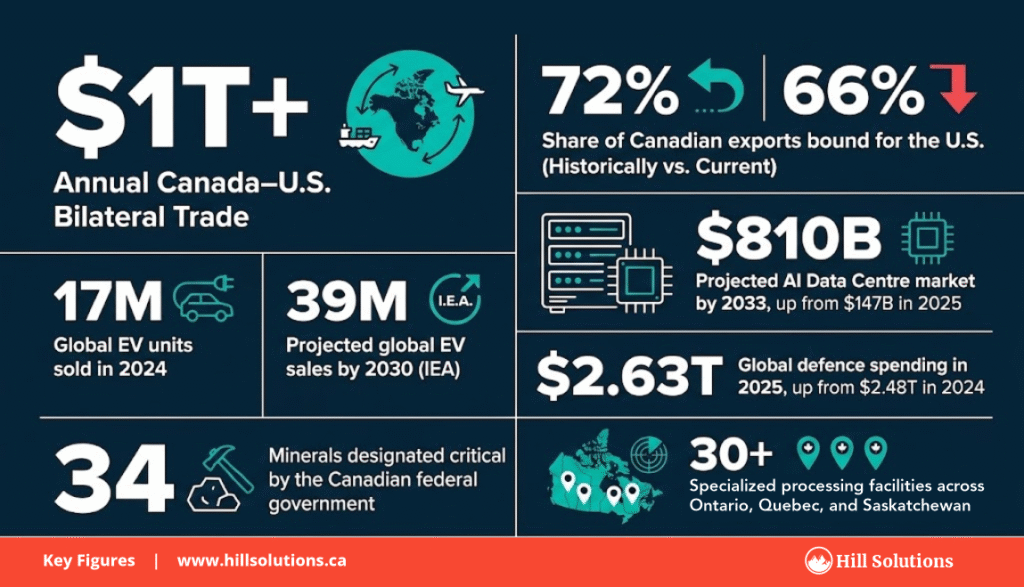
Canada is the United States’ second largest trading partner, with bilateral trade exceeding one trillion dollars annually. Historically, the United States has absorbed roughly 72 percent of all Canadian exports, making it by far Canada’s most important and most consequential economic relationship.
Since the onset of the trade conflict between the two countries, that figure has declined to approximately 66 percent as Canadian exporters have begun redirecting shipments toward European and Asian markets. The shift is meaningful, but it does not alter the fundamental reality: the shared energy infrastructure, integrated supply chains, and deep capital linkages between Canada and the United States leave Canada with limited capacity to meaningfully reduce dependency in the near term.
The Push for Canadian Economic Sovereignty
This structural exposure has moved economic sovereignty to the centre of Canadian policy debate. The central question for policymakers is no longer simply how to manage the bilateral relationship, but how Canada can build economic resilience and strategic autonomy without severing the trade flows on which its prosperity depends.
Critical minerals offer Canada’s most viable pathway toward that objective. Canada holds large reserves of minerals that allied economies urgently need, occupies a trusted position within frameworks of strategic trade, and is uniquely placed to supply materials to markets that extend beyond North America. Critical minerals can reduce Canada’s vulnerability to U.S. pressure, deepen its relationships with allied partners, and lay the foundation for a more diversified and independent economy.
“Every electric vehicle sold in Europe, every data centre commissioned in Japan, and every weapons system procured by a NATO ally represents demand that Canada can fulfill with its natural resources.“
Canadian Mineral Endowments and Extraction Capacity
Canada possesses an incredible advantage over the vast majority of economies when it comes to mineral endowments and critical mineral supply chains. The Canadian Shield — one of the world’s largest stable rock formations — contains extraordinary concentrations of critical minerals including nickel, cobalt, copper, uranium, and rare earth elements.
Canada also possesses over 30 specialized processing facilities in Ontario, Quebec, and Saskatchewan, providing a foundation of capital and industrial infrastructure that can be scaled to meet growing global demand.
Conclusion: Achieving Sovereignty Through Supply
Canada stands at an inflection point. The trade conflict with the United States has exposed a structural vulnerability in an economy whose prosperity has been largely dependent on a single bilateral relationship.
Critical minerals do not resolve that vulnerability overnight, but they offer Canada a chance to become a major supplier of goods that form the basis of new foreign trade relationships and meaningful economic diversification. Every electric vehicle sold in Europe, every data centre commissioned in Japan, and every weapons system procured by a NATO ally represents demand that Canada can fulfill with its natural resources. The Canadian government must now develop the economic policies necessary to fully capitalize on this opportunity — before the strategic window closes and other suppliers move to fill it.